
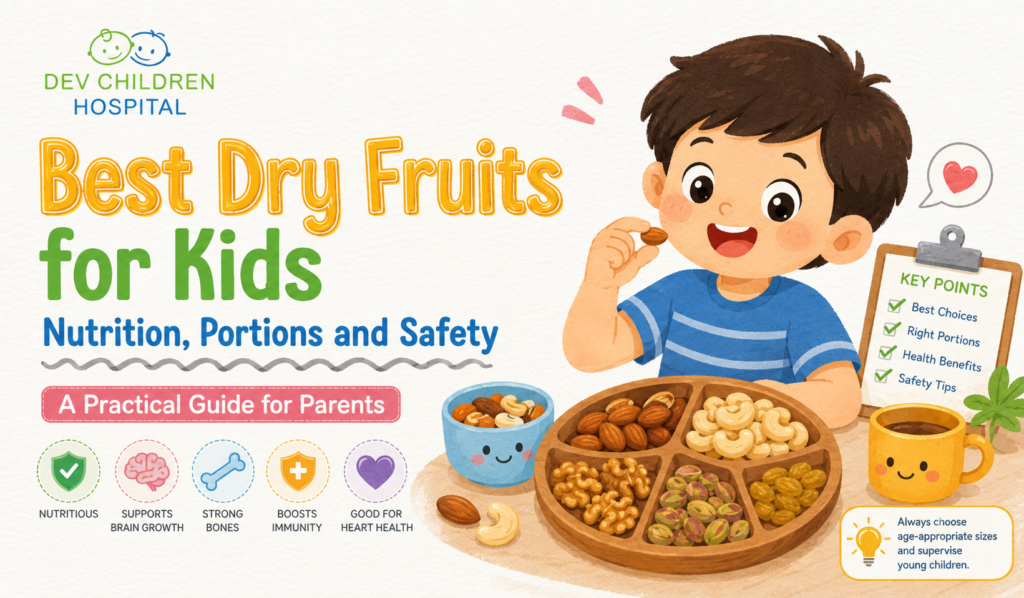
Dry fruits and nuts are popular choices among parents who want to provide their children with nutritious snacks. Almonds, walnuts, cashews, raisins, dates and anjeer contain different combinations of healthy fats, protein, fibre, vitamins and minerals.
However, there is no single dry fruit that is best for every child. The right choice depends on the child’s age, nutritional needs, chewing ability, overall diet and allergy history.
Instead of depending on one particular dry fruit, parents can offer a small variety in an age-appropriate form. Dry fruits should be part of a balanced diet and should not replace fresh fruits, vegetables, grains, pulses, dairy products or other protein-rich foods.
Is There One Best Dry Fruit for Every Child?
No single dry fruit provides every nutrient a growing child needs.
Almonds and walnuts provide healthy fats and protein. Cashews are energy-dense and contain important minerals. Raisins, dates, anjeer and prunes provide fibre and natural sweetness.
For most children, offering a small variety is better than giving large amounts of only one type. Parents should also remember that dried fruits and nuts are concentrated foods. Small child-sized portions are usually enough.
Best Dry Fruits and Nuts for Kids
Dry fruit or nut | Important nutrients | Why parents may include it | Child-friendly serving method |
Almonds | Healthy fats, protein, vitamin E and magnesium | Useful for adding energy and nutrients to meals | Powdered, finely crushed or as thin almond butter |
Walnuts | Unsaturated fats, protein and minerals | Adds healthy fats to a balanced diet | Finely ground or crushed |
Cashews | Healthy fats, protein, magnesium and zinc | Energy-dense and easy to include in meals | Ground, powdered or made into a smooth paste |
Raisins | Fibre, carbohydrates and some minerals | Adds natural sweetness to food | Soften and finely chop for younger children |
Dates | Fibre, natural sugar and minerals | Can sweeten homemade recipes | Remove the seed and mash or finely chop |
Anjeer | Fibre and minerals | Can be added to porridge or curd | Soak, mash or chop into small pieces |
Pistachios | Healthy fats, protein and minerals | Provides variety in a mixed nut intake | Use plain, unsalted and finely ground |
Prunes | Fibre and natural sugars | Can be included as a source of dietary fibre | Soak and puree or finely chop |
Dried apricots | Fibre and carotenoids | Adds variety and natural sweetness | Select unsweetened varieties and chop finely |
The nutritional value of each option varies, so parents do not have to choose only one. A mixture of almonds, walnuts, cashews and suitable dried fruits can be rotated across the week.
Are Almonds Good for Kids?
Almonds are one of the most commonly offered nuts for children. They contain healthy fats, protein, vitamin E and several minerals.
Parents can add almonds to a child’s regular food in simple ways:
- Mix almond powder into porridge.
- Add finely ground almonds to atta.
- Spread a thin layer of smooth almond butter on toast.
- Add crushed almonds to curd.
- Mix almond paste into homemade kheer.
- Add almond powder to banana or oats.
Soaking almonds is a family preference, but it is not compulsory. A soaked almond can still cause choking when served whole to a young child. It must be ground, crushed or prepared according to the child’s chewing ability.
Are Walnuts Good for Kids?
Walnuts contain unsaturated fats, protein and minerals. They can be included as part of a balanced and varied diet.
Walnuts are often promoted as a food that guarantees better memory or intelligence. Parents should avoid such unrealistic claims. No single food can determine a child’s brain development or academic performance.
Healthy ways to include walnuts are:
- Ground walnut powder in oats
- Crushed walnuts mixed with curd
- Walnut paste added to homemade food
- Ground walnuts mixed into atta
- Crushed walnuts with mashed banana
Start with a small amount when the child is eating walnuts for the first time.
Are Cashews Good for Children?
Cashews provide healthy fats, protein and minerals such as magnesium and zinc. Since they are energy-dense, they may be useful for adding calories to the diet of children who need more energy.
However, cashews should not be treated as a guaranteed solution for poor weight gain. A child who is not gaining weight appropriately should be evaluated by a pediatrician.
Cashews can be served as:
- Fine cashew powder
- Smooth cashew paste
- Ground cashews added to porridge
- Powdered cashews mixed into atta
- Crushed cashews added to upma
- Cashew paste added to homemade curries
Avoid salted, fried or heavily flavoured cashews for regular consumption.
Are Raisins Good for Kids?
Raisins contain carbohydrates, fibre and natural sugar. They can add sweetness to porridge, oats and homemade food without adding table sugar.
However, raisins are sticky and can remain on the teeth. They should preferably be included with a meal rather than offered continuously throughout the day.
For younger children:
- Soften raisins before serving.
- Cut them into very small pieces.
- Mix them into porridge or curd.
- Avoid giving whole raisins to babies.
- Supervise the child while eating.
Raisins should not be offered as an unlimited snack simply because they come from fruit.
Are Dates and Anjeer Good for Kids?
Dates and anjeer are concentrated dried fruits containing fibre and natural sugars. They can be included in small quantities as part of a balanced meal.
Healthy ways to use dates
- Remove the seed completely.
- Mash dates into porridge.
- Prepare smooth date paste.
- Add a small amount to homemade laddoos.
- Use dates instead of extra sugar in selected recipes.
Healthy ways to use anjeer
- Soak anjeer to soften it.
- Mash it for babies who are ready for complementary foods.
- Mix it into curd or porridge.
- Chop it into small pieces for older children.
- Avoid giving large, tough pieces to toddlers.
Choose plain products without added sugar, syrup or artificial flavouring.
Which Dry Fruit Is Best for Different Needs?
Parent’s concern | Dry fruits or nuts that may be included | Important point |
Everyday balanced nutrition | Almonds, walnuts and cashews | Offer variety instead of relying on one nut |
Healthy fats | Almonds, walnuts, cashews and pistachios | Select plain and unsalted options |
Dietary fibre | Raisins, anjeer, prunes and dried apricots | Fresh fruits, vegetables and grains remain important |
Energy-dense meals | Cashews, dates and nut pastes | Portion size must suit the child’s age |
Natural sweetness | Dates, raisins and anjeer | Avoid products containing added sugar |
Poor appetite | Nut powder or smooth nut paste | Persistent poor appetite needs medical assessment |
Poor weight gain | Nuts and nut pastes may add energy | Dry fruits cannot replace proper diagnosis |
Constipation concerns | Prunes, anjeer or raisins | Persistent constipation should be discussed with a doctor |
Dry fruits should not be promoted as foods that directly increase height, cure anaemia, prevent every infection or guarantee better brain development.
At What Age Can Children Eat Dry Fruits?
Nuts may be introduced in a safe form after a baby begins complementary feeding and is developmentally ready. They should be finely ground or offered as a smooth, thin nut paste mixed with familiar food.
Whole nuts should not be given to young children because they are a choking hazard. Whole raisins, dates and hard dried-fruit pieces may also be difficult for babies and toddlers to chew safely.
Age group | Safer form | Foods and textures to avoid |
Around 6–12 months | Fine nut powder mixed into food, smooth nut paste and mashed softened dried fruit | Whole nuts, nut pieces, thick spoonfuls of nut butter and whole dried fruit |
1–3 years | Ground nuts, thin nut butter and softened, finely chopped dried fruit | Whole nuts and hard, sticky pieces |
4–5 years | Finely crushed or chopped nuts according to chewing skills | Whole hard nuts when the child cannot chew safely |
Older children | Plain nuts and dried fruits in controlled portions | Salted, fried, sugar-coated or chocolate-coated products |
A child’s chewing ability and development are more important than age alone. Children should sit upright and remain supervised while eating. They should not run, play or lie down with food in their mouth.
How Much Dry Fruit Should Kids Eat Daily?
There is no single fixed number of almonds, walnuts or raisins that is suitable for every child. The amount depends on:
- Age
- Appetite
- Body size
- Physical activity
- Overall diet
- Growth pattern
- Medical conditions
- Allergy history
Dry fruits and nuts are concentrated sources of energy, so small portions are usually sufficient. Large portions can reduce a child’s appetite for regular meals.
Parents can follow these practical tips:
- Start with a very small amount when introducing a new food.
- Offer a small child-sized portion.
- Include one or two types at a time.
- Rotate different options across the week.
- Avoid allowing children to graze on dry fruits all day.
- Offer dried fruits with meals.
- Choose fresh fruits more frequently for regular snacks.
- Do not force children to eat a fixed number every day.
Children who have poor growth, obesity, diabetes, digestive problems or food allergies may require personalised advice.
Should Dry Fruits Be Soaked Before Giving Them to Kids?
Soaking can soften almonds, raisins, dates and anjeer, making them easier to mash or add to recipes. However, soaking is not compulsory and does not automatically make the food safe.
A soaked nut can still cause choking when served whole. Soaking also does not remove the possibility of an allergic reaction.
When soaking dry fruits:
- Wash them properly.
- Use clean drinking water.
- Refrigerate them when soaking for several hours.
- Remove seeds from dates.
- Mash or chop them according to age.
- Do not leave soaked foods at room temperature for long periods.
- Discard anything with an unusual smell, colour or texture.
Healthy Ways to Add Dry Fruits to a Child’s Diet
Dry fruits do not always need to be served separately. Parents can add small quantities to familiar homemade meals.
Try these ideas:
- Almond powder in oats or porridge
- Ground walnuts mixed with banana
- Cashew paste added to vegetable dishes
- Nut powder mixed into roti atta
- Softened raisins added to breakfast dishes
- Mashed dates added to homemade recipes
- Soaked anjeer mixed with curd
- A thin layer of smooth nut butter on toast
- Ground nuts added to idli or dosa batter
- Nut paste added to khichdi
- Small homemade dry-fruit laddoos
- Crushed nuts added to fruit and curd bowls
Avoid adding large amounts of sugar, jaggery, honey or chocolate while preparing dry-fruit recipes.
What Should Parents Check Before Buying Dry Fruits?
Check the packaging and ingredients carefully before purchasing products for children.
Choose dry fruits that are:
- Plain and unsalted
- Free from added sugar
- Free from sugar syrup
- Without artificial colour
- Without excessive flavouring
- Properly sealed
- Within the expiry date
- Free from visible moisture or mould
- Stored according to the package instructions
Avoid regular use of:
- Salted nuts
- Deep-fried nuts
- Sugar-coated almonds
- Chocolate-coated dry fruits
- Honey-roasted nuts
- Artificially flavoured nut mixtures
- Dried fruits containing added syrup
- Mixtures containing candies
- Products with unclear ingredient labels
Store nuts and dried fruits in clean, airtight containers in a cool and dry place.
Can Dry Fruits Cause Allergies?
Tree nuts such as almonds, walnuts, cashews and pistachios can cause allergic reactions in some children. Reactions may occur even after eating a small amount.
Possible allergy symptoms include:
- Hives or an itchy rash
- Swelling of the lips, face or eyes
- Vomiting
- Persistent coughing
- Wheezing
- Breathing difficulty
- Voice changes
- Sudden weakness
- Dizziness or collapse
Stop feeding the suspected food if symptoms appear and seek medical help. Breathing difficulty, tongue or throat swelling, severe wheezing, collapse or rapidly worsening symptoms require immediate emergency care.
Do not test the suspected food again at home without medical guidance.
Can Dry Fruits Help Children Gain Weight?
Nuts, nut pastes and dried fruits are energy-dense, so they can add calories to a child’s meals. They may be mixed into porridge, curd, atta or other familiar foods.
However, dry fruits alone cannot correct poor growth. A child may have poor weight gain because of inadequate food intake, feeding difficulties, digestive conditions, repeated infections or another health concern.
Parents should consult a pediatrician if the child:
- Is not gaining weight
- Is losing weight
- Has a very poor appetite
- Refuses most foods
- Vomits repeatedly
- Has frequent diarrhoea or constipation
- Appears weak or unusually tired
- Has difficulty chewing or swallowing
When Should Parents Consult a Pediatrician?
Seek professional guidance when a child has:
- Poor weight gain
- Sudden weight loss
- Persistent poor appetite
- Repeated stomach pain
- Frequent constipation
- Recurrent diarrhoea
- Repeated vomiting
- Difficulty chewing or swallowing
- Choking or gagging during meals
- A suspected nut allergy
- Swelling or breathing difficulty after eating
- Extreme food restriction
- Difficulty starting complementary foods
- A diagnosed medical condition requiring a special diet
A pediatrician can assess the child’s growth, diet and health before recommending dietary changes or supplements.
Trusted Pediatric Care at Dev Children Hospital
Dev Children Hospital exists to put children’s health first. The hospital combines advanced pediatric expertise with a caring and child-friendly approach so that newborns, infants, children and adolescents receive timely, accurate and safe medical care.
The pediatric team provides support for neonatal care, routine health check-ups, vaccinations, pediatric emergencies and critical care. Modern infrastructure, Level-3 NICU and PICU facilities help the hospital provide care for both routine and serious childhood health concerns.
Dev Children Hospital’s Promise to Families
- Expert pediatric and neonatal doctors
- Ethical and transparent treatment
- Hygienic and child-safe spaces
- 24×7 pediatric emergency support
- Advanced Level-3 NICU facilities
- Advanced Level-3 PICU facilities
- Routine health and growth monitoring
- Vaccination and immunisation support
- Compassionate and child-friendly care
- Clear communication with parents
Parents who are concerned about their child’s diet, poor appetite, food allergy, growth or digestive health can consult the pediatric team for personalised guidance.
Frequently Asked Questions
Which is the best dry fruit for kids?
There is no single best option. Almonds, walnuts, cashews, raisins, dates and anjeer provide different nutrients. Offering a small variety in an age-appropriate form is generally more useful than depending on only one type.
Are almonds good for children every day?
Almonds can be included as part of a balanced diet. The quantity should suit the child’s age, appetite and overall food intake. Ground or crushed almonds are safer for younger children.
Can a one-year-old eat dry fruits?
A one-year-old should not be given whole nuts. Nuts should be finely ground or provided as a smooth paste mixed into food. Dried fruits should be softened, mashed or finely chopped.
Which dry fruit is good for a child’s weight gain?
Nuts, nut pastes, dates and anjeer are energy-dense. However, poor weight gain should be assessed by a pediatrician rather than managed only by increasing dry fruits.
Are walnuts good for brain development?
Walnuts provide healthy fats and other nutrients that can be part of a balanced diet. However, no food can guarantee improvements in memory, intelligence or academic performance.
Can children eat raisins every day?
Raisins may be included in small quantities. They are best offered with meals rather than frequently between meals. Their texture should be modified for babies and toddlers.
Should almonds be soaked before giving them to children?
Soaking is optional. It may soften almonds, but a soaked whole almond can still cause choking. Grind or crush it according to the child’s age and chewing ability.
Can dry fruits cause allergies?
Yes. Tree nuts can cause allergic reactions. Seek emergency medical help if the child develops breathing difficulty, tongue or throat swelling, severe wheezing or collapse after eating.