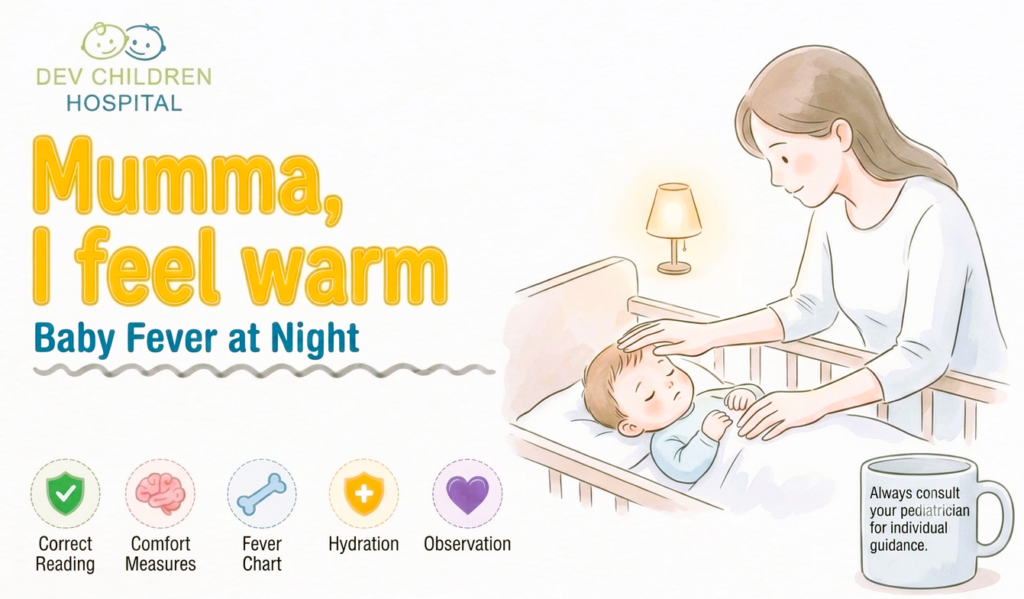
It is 2:00 AM. The house is quiet, but your heart is racing as you press the back of your hand against your little one’s forehead. It feels hot-too hot. You check the thermometer, and the number confirms your worst fear. In those dark, quiet hours, baby fever at night can feel like a terrifying emergency, triggering panic and exhaustion in equal measure.
As a children’s doctor at Dev Children Hospital, Vadodara, I want to start by validating that fear. Every parent has been there. But I also want to offer you clarity. Fever is not a disease; it is a symptom. It is your child’s immune system doing exactly what it was designed to do: fighting an infection. Understanding why fevers spike at night, knowing the true red flags, and having a plan for safe fever relief for babies can transform that midnight panic into confident, compassionate care. This guide will walk you through everything you need to know, backed by medical science and years of pediatric experience.
Why Does Fever Often Spike at Night?
One of the most common questions parents ask is, “Why does my baby seem fine during the day but burn up at night?” The answer lies in human biology, specifically our circadian rhythms.
Our bodies produce cortisol, a natural steroid hormone that suppresses inflammation and keeps our immune response in check during daylight hours. As evening falls, cortisol levels naturally drop, allowing the immune system to become more active. This increased activity often manifests as a rising temperature. Additionally, body temperature naturally fluctuates throughout the day, peaking in the late afternoon and evening. So, when you notice fever in infants worsening after bedtime, it is often a sign that their immune system is actively working, not necessarily that their condition is suddenly deteriorating. Understanding this biological rhythm can help reduce anxiety and prevent unnecessary midnight trips to the ER for manageable fevers.
Accurate Temperature Taking: Getting It Right
Before you can make any decisions, you need an accurate reading. Not all thermometers are created equal, and method matters significantly based on age.
- Rectal Thermometers: For infants under 3 months, this remains the gold standard for accuracy. A rectal temperature of 100.4°F (38°C) or higher is considered a true fever in this age group.
- Temporal (Forehead) or Axillary (Armpit): For babies over 3 months, these methods are generally reliable if used correctly. Always follow the manufacturer’s instructions precisely.
- Avoid: Ear thermometers can be inaccurate in infants due to small ear canals. Forehead strips are notoriously unreliable and should never be used for medical decision-making.
When tracking fever in infants, always note the time, temperature, method used, and any medication given. This log is invaluable if you need to consult a doctor.
Age-Based Red Flags: When “Baby Fever at Night” Is an Emergency
The most critical factor in evaluating a fever is your baby’s age. Guidelines change dramatically in the first few months of life.
0 to 3 Months: Immediate Medical Attention Required
If your newborn or young infant has a rectal temperature of 100.4°F (38°C) or higher, this is a medical emergency. Do not wait until morning. Do not give medication and “see if it goes down.” Babies this young have immature immune systems and can develop serious bacterial infections rapidly. Go directly to the nearest pediatric emergency room.
3 to 6 Months: Caution and Consultation
A fever of 102°F (38.9°C) or higher warrants a call to your pediatrician or a visit to urgent care, especially if it occurs at night. If your baby seems unusually lethargic, irritable, or refuses feeds, seek care regardless of the exact temperature. These are signs of serious illness in babies that should never be ignored.
6 Months and Older: Focus on Behavior
For older infants, the number on the thermometer is less important than how your child looks and acts. A baby with a 103°F fever who is drinking fluids, making eye contact, and consolable may be safely managed at home. Conversely, a baby with a 101°F fever who is limp, unresponsive, or breathing abnormally needs immediate evaluation. Trust your instincts, if something feels wrong, it probably is.
Safe Home Care: How to Comfort Your Child
When you’ve ruled out emergencies and your pediatrician advises home management, focus on comfort rather than chasing a normal temperature. Here are evidence-based strategies for safe fever relief for babies:
- Hydration is Priority: Offer frequent breastfeeds or formula feeds. For babies over 6 months, small sips of water or oral rehydration solution can help prevent dehydration. Watch for wet diapers at least one every 6-8 hours is a good sign.
- Dress Lightly: Over-bundling traps heat. Dress your baby in lightweight, breathable clothing. Keep the room comfortably cool (around 70-74°F or 21-23°C).
- Lukewarm Sponge Bath (Optional): Only use this if it visibly comforts your baby. Use lukewarm not cold-water. If your baby shivers, cries, or seems distressed, stop immediately. Shivering raises core body temperature, defeating the purpose. Never use alcohol rubs; they can be absorbed through the skin and cause toxicity.
Medication Safety: Dosage & Warnings
Medication should only be used if your baby is uncomfortable, not solely to normalize the thermometer reading. Always consult your pediatrician before giving any medication to an infant under 6 months.
- Acetaminophen (Paracetamol): Safe for infants over 2-3 months (check with your doctor first). Dosing is based on weight, not age. Never guess-use the syringe provided with the medication and confirm the dose with your healthcare provider.
- Ibuprofen: Only safe for babies 6 months and older. It can be more effective for high fevers but should never be given to younger infants due to kidney risks.
- CRITICAL WARNING: NEVER give aspirin to children or teenagers. Aspirin is linked to Reye’s Syndrome, a rare but potentially fatal condition affecting the liver and brain.
When practicing safe fever relief for babies, remember that medication takes 30-60 minutes to work. Be patient, and avoid alternating acetaminophen and ibuprofen unless explicitly instructed by your doctor, as this increases the risk of dosing errors.
Recognizing Signs of Serious Illness in Babies Beyond Fever
Parents often fixate on the thermometer, but the most important diagnostic tool is your observation of your child’s overall state. Signs of serious illness in babies extend far beyond temperature:
- Breathing Difficulties: Fast breathing, flaring nostrils, grunting sounds, or visible retractions (skin pulling in between ribs or above collarbone).
- Dehydration: No wet diaper for 6+ hours, dry mouth, sunken soft spot (fontanelle), or absence of tears when crying.
- Altered Mental State: Extreme lethargy (difficult to wake), inconsolable crying lasting hours, or unusual limpness/floppiness.
- Rash: Any rash that doesn’t blanch (fade) when pressed, especially purple or red spots, requires immediate emergency evaluation as it can indicate meningitis or sepsis.
- Seizures: Febrile seizures can occur with rapid temperature spikes. While often benign, any first-time seizure requires emergency assessment.
If you observe any of these signs of serious illness in babies, do not wait. Seek emergency care immediately, even if the fever itself seems moderate.
What NOT to Do During a Fever
Misinformation abounds, and some well-meaning remedies can be harmful. Avoid these dangerous practices:
- No Cold Baths or Ice Packs: These cause shivering, which generates more internal heat and increases discomfort.
- No Alcohol Rubs: Alcohol can be absorbed through infant skin and cause poisoning or hypoglycemia.
- No Heavy Bundling: “Sweating it out” is a myth. Overdressing prevents heat dissipation and can dangerously raise core temperature.
- No Adult Medications: Never give adult formulations or doses to infants.
- No Delaying Care for Young Infants: The “wait and see” approach is never appropriate for babies under 3 months with fever.
Prioritizing safe fever relief for babies means avoiding these outdated and potentially harmful practices.
When to Visit Dev Children Hospital’s 24×7 Emergency
Even with the best home care, situations arise that require professional evaluation. Visit our emergency department if:
- Your baby is under 3 months with any fever ≥100.4°F (38°C).
- Your baby shows any signs of serious illness in babies listed above.
- Fever persists beyond 24 hours in infants under 2 years, or 72 hours in older children.
- You are unable to keep your baby hydrated.
- Your parental instinct tells you something is seriously wrong.
At Dev Children Hospital, our 24×7 pediatric emergency team is always ready. We understand that baby fever at night brings unique stress, and we are here to provide rapid, compassionate, expert care whenever you need it.
Trusted Pediatric Emergency Care at Dev Children Hospital, Vadodara
Your child’s health cannot wait for business hours. As a dedicated children’s hospital in Vadodara, we provide comprehensive, round-the-clock care for newborns, infants, and children up to 18 years. Our facility includes:
- 24×7 Pediatric Emergency Department staffed by experienced pediatricians
- Level-3 NICU and PICU for critical care backup
- Advanced diagnostics including pediatric-specific lab and imaging
- Routine vaccinations, growth monitoring, and developmental assessments
From midnight fevers to routine check-ups, we offer dependable support that keeps your child safe, healthy, and comforted in a child-friendly environment designed to reduce anxiety for both patients and parents.
Frequently Asked Questions (FAQs)
Q1: Can I wake my sleeping baby to give fever medicine?
Generally, no. Sleep is healing, and rest is more beneficial than medication for a comfortable, sleeping child. Wake your baby only if they are showing signs of distress, difficulty breathing, or if your doctor has specifically instructed timed dosing. Monitoring baby fever at night includes respecting their need for restorative sleep.*
Q2: My baby has a fever but is playing happily. Should I worry?
Behavior is often more telling than temperature. A happy, interactive, hydrated baby with a fever is usually less concerning than a lethargic baby with a lower fever. Continue monitoring fever in infants alongside behavioral cues. However, if your baby is under 3 months, any fever requires immediate medical evaluation regardless of behavior.*
Q3: How long should a fever last before I see a doctor?
For infants under 2 years, contact your pediatrician if fever lasts more than 24 hours. For children 2 years and older, 72 hours is the general threshold. However, trust your instincts, if your child seems to be worsening or you notice signs of serious illness in babies, seek care sooner rather than later.*
Q4: Is teething really the cause of my baby’s high fever?
Teething may cause a very mild temperature elevation (under 100.4°F), but it does NOT cause high fevers. If your baby has a significant fever, do not assume it’s teething. Look for other causes and consult your pediatrician. Misattributing fever to teething can delay diagnosis of genuine infections requiring treatment.*
Q5: Can I use a fan or AC in the room when my baby has a fever?
Yes. Maintaining a comfortable room temperature (70-74°F / 21-23°C) helps with safe fever relief for babies. A fan can improve air circulation, but avoid pointing it directly at your baby. Air conditioning is perfectly safe and can prevent overheating. The goal is comfort, not chilling.*